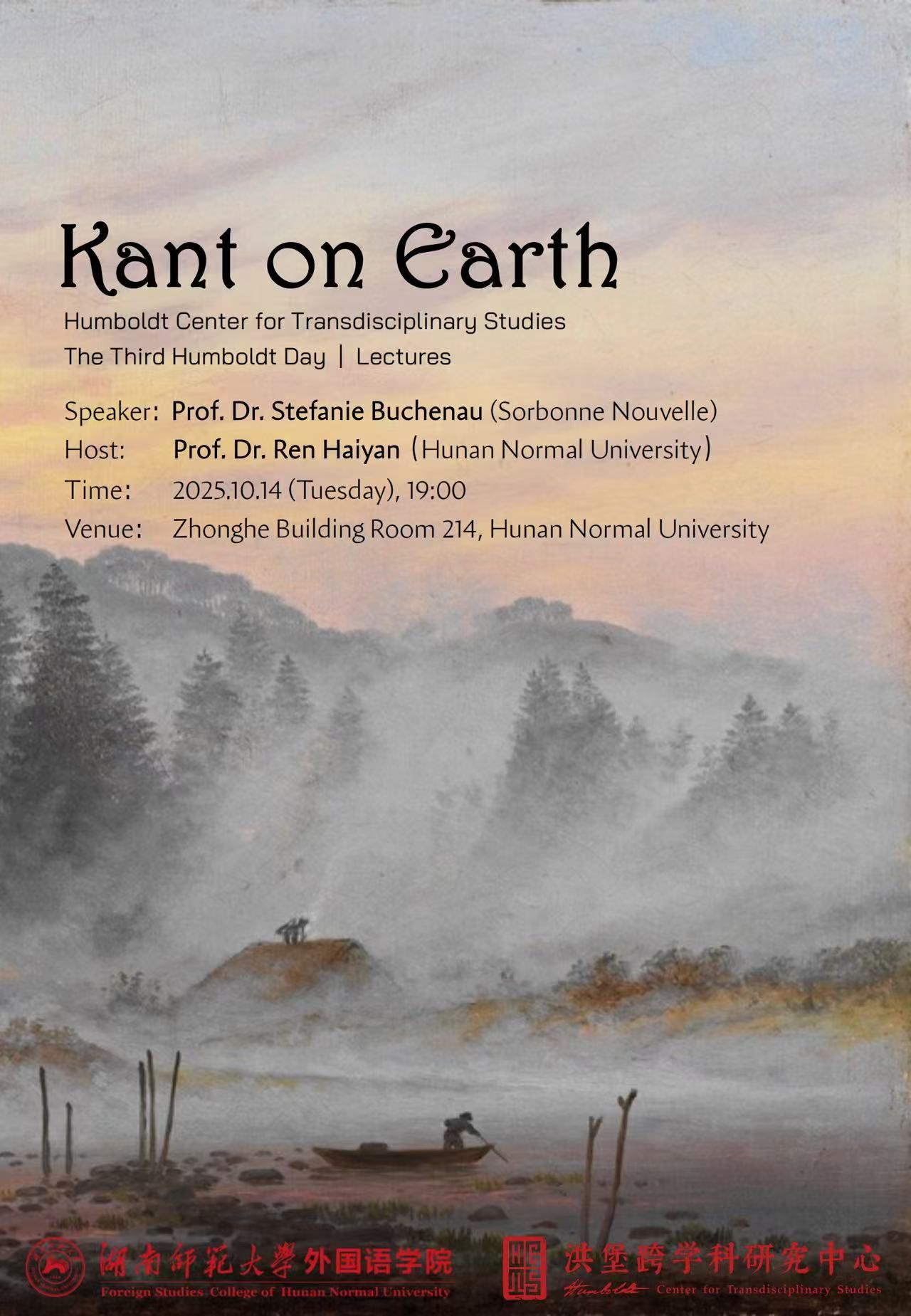
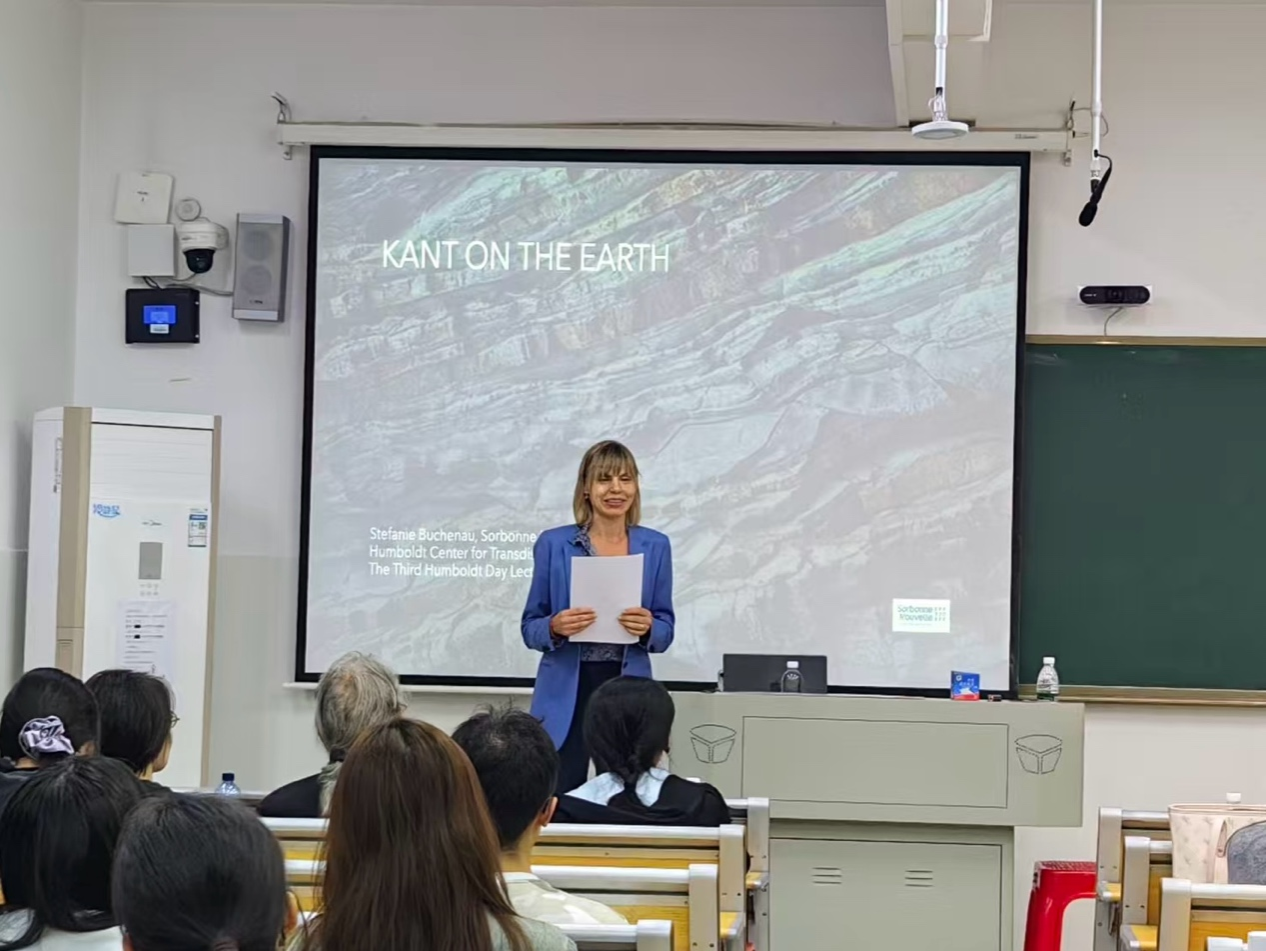
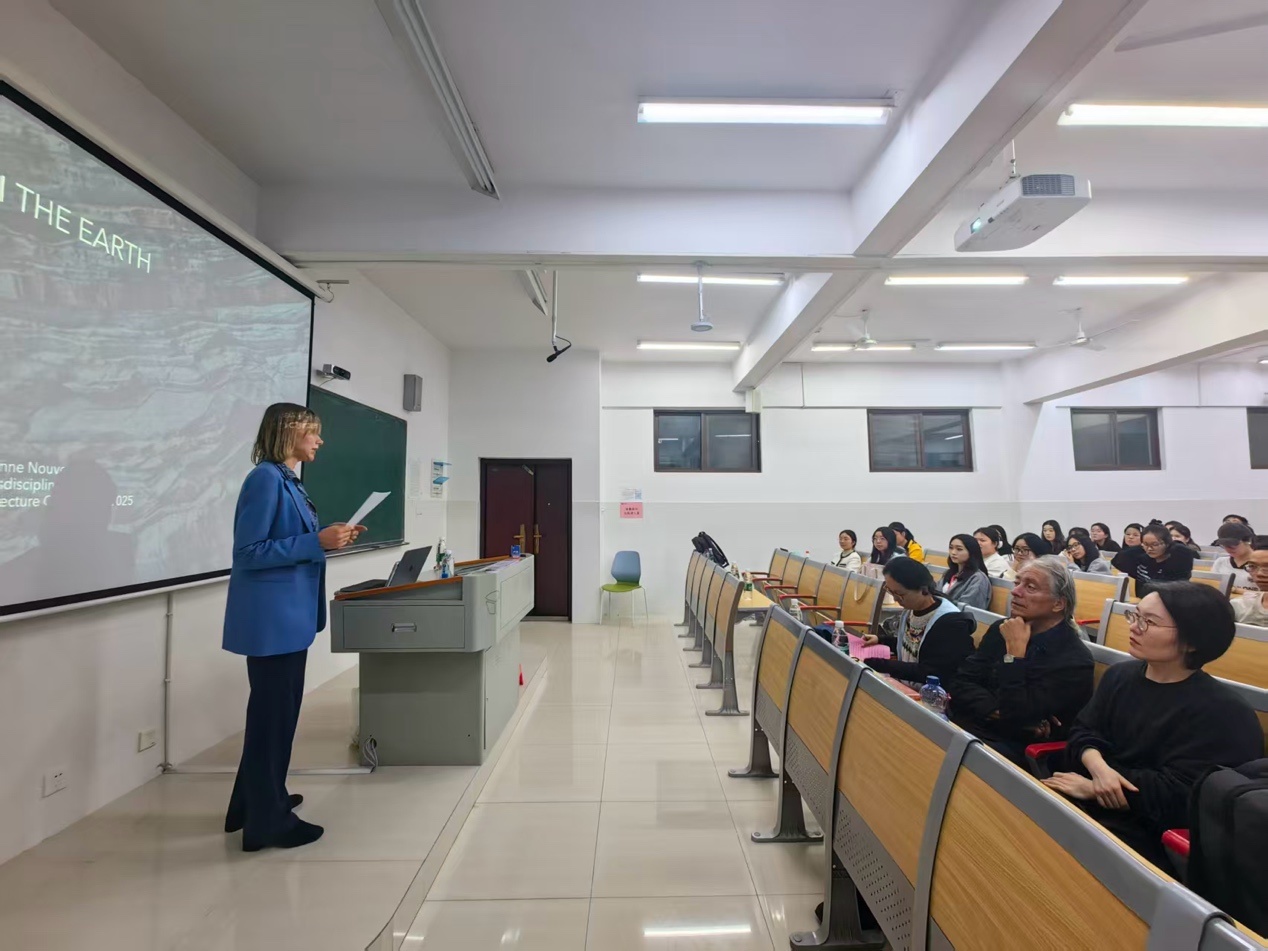
On the evening of October 14, the Humboldt Interdisciplinary Research Center at Hunan Normal University convened a scholarly lecture titled "Kant on Earth" in the Zhonghe Building. Organized as a flagship event of the third annual "Humboldt Day" series, the session featured Professor Stefanie Buchenau, a distinguished scholar of German intellectual history from the University of Sorbonne Nouvelle (Paris III). Presided over by Professor Ren Haiyan of the School of Foreign Languages, the lecture delved into Immanuel Kant’s early geographical writings, illuminating the profound yet often overlooked intrinsic connections between his terrestrial inquiries and his later critical philosophical system.
Professor Buchenau began by addressing the historical reception of Kant’s geographical contributions. She highlighted that Kant was not only a founding figure of modern Western geography in the 18th century but also a dedicated educator who delivered 49 cycles of physical geography lectures over a forty-year career. Despite this substantial volume of work, these texts have long been marginalized within academia as pre-critical anomalies or dismissed as mere popular science written for financial subsistence. Professor Buchenau argued that such perspectives severely undervalue the centrality of geographical thinking in Kant’s intellectual architecture and obscure the holistic logic of his philosophical development.
Advancing her thesis, Buchenau posited that Kant’s geographical reflections were neither accidental nor peripheral; rather, they constituted a vital prerequisite for the establishment of his critical philosophy. She demonstrated that Kant’s philosophical concept of "orientation"—using cartographic tools to navigate the world—finds its intellectual roots in his early systematic reflection on geographical space, revealing a rigorous logical lineage between the two domains.
The lecture then turned to a close reading of key early texts. In his 1755 work Universal Natural History and Theory of the Heavens, Kant displayed a macroscopic cosmic vision, attempting to synthesize mechanism with teleology and material infinity with moral order. His writing therein already contained profound insights into humanity's marginal yet appropriate position in the universe, reflecting a foresight that transcended his era. Furthermore, in analyzing three essays penned in the wake of the catastrophic 1755 Lisbon earthquake, Buchenau illustrated how Kant employed reason and science to reject theological fatalism. Instead, he investigated geological causes and proposed forward-looking frameworks for risk assessment, fully embodying the Enlightenment ethos of rationality and scientific inquiry.
Professor Buchenau also drew attention to the cartographic cognitive model introduced in Kant’s Announcement of Lectures on Physical Geography. She noted that his conceptualization of humans as "stewards of the earth" and his advocacy for observing the world with the "curiosity of a traveler" were not isolated ideas. These concepts persisted and deepened in his later anthropological studies and even in the Critique of Pure Reason. She concluded that Kant’s early geographical works provided the essential intellectual substrate for his anthropology and critical philosophy, marking the geographical dimension as an indispensable element of his thought.
During the subsequent Q&A session, the atmosphere was vibrant as scholars and students engaged in a spirited dialogue. Topics included the tension between Kant’s "sedentary" perspective—having never traveled extensively—and his universalist philosophy, the methodological characteristics of his scientific research, and the intersection of his geographical thought with global history. These intellectual exchanges further expanded the audience's understanding of the subject matter.
This lecture successfully unveiled the long-neglected geographical dimension of Kantian philosophy. It not only provided a novel entry point for broadening the horizons of Kantian scholarship but also offered a crucial reference for re-examining the interplay between philosophy and science during the Enlightenment, holding significant heuristic value for future research in the field.