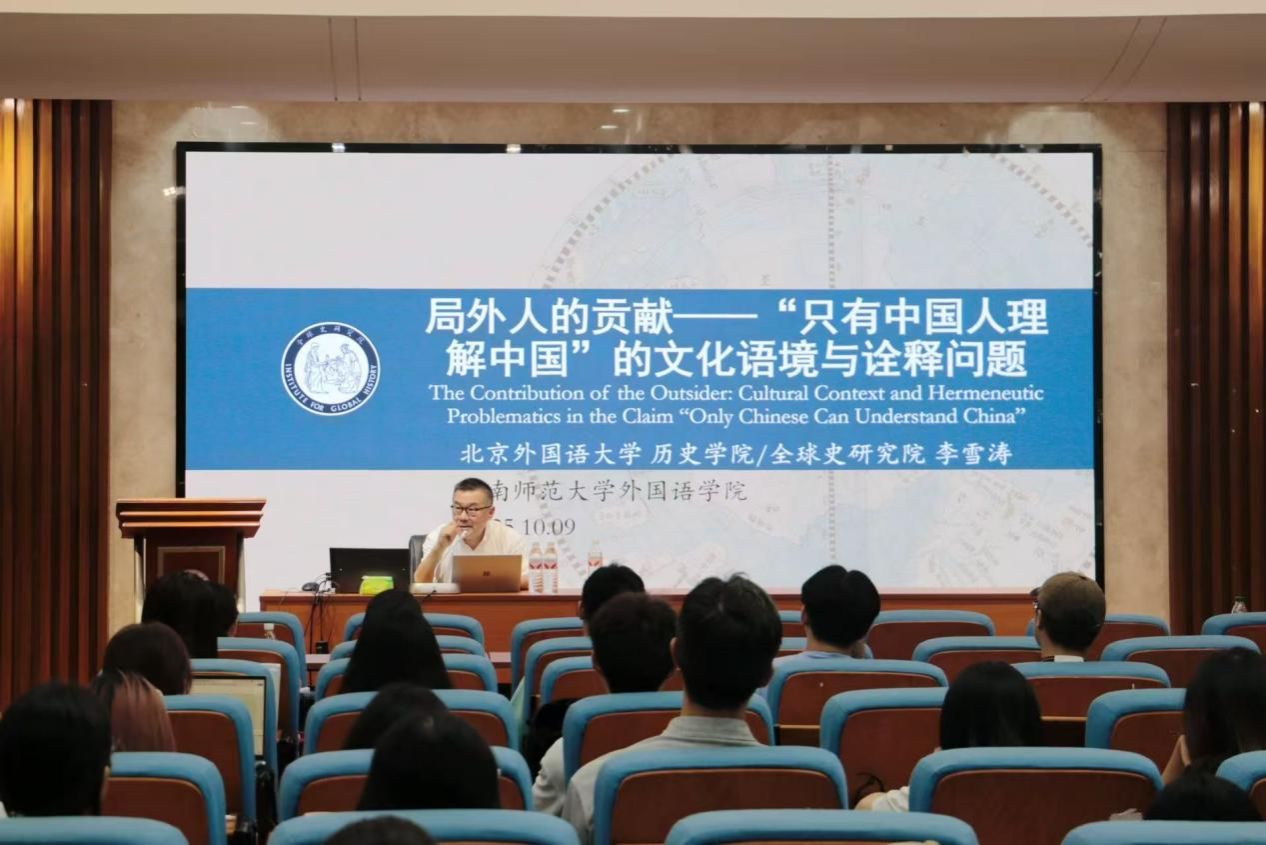
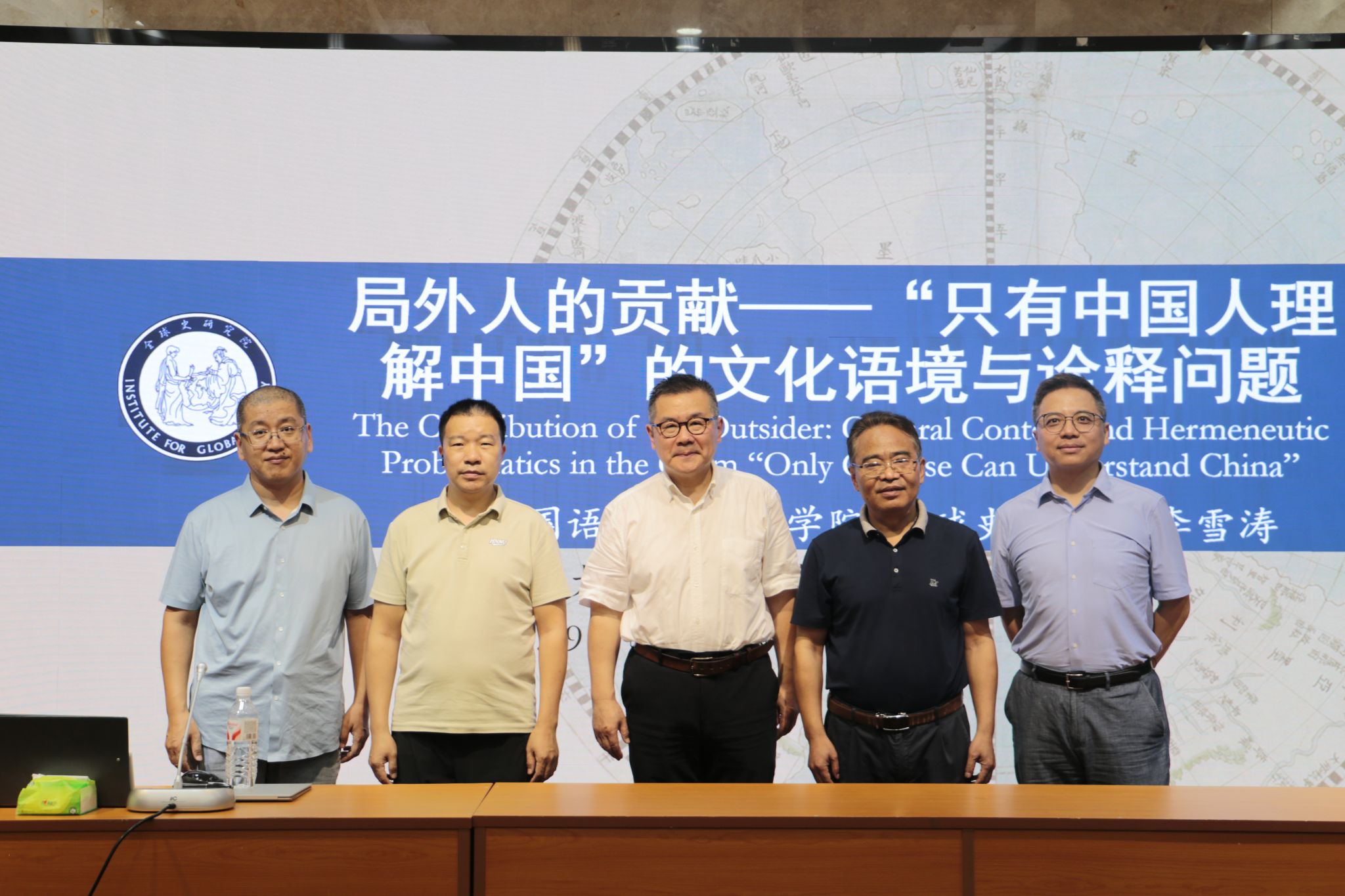
On the evening of October 10, 2025, Professor Li Xuetao, Dean of the School of History and Culture at Beijing Foreign Studies University, was invited to Hunan Normal University to deliver a special lecture titled “The Contribution of the Outsider: The Cultural Context and Hermeneutic Issues of ‘Only the Chinese Understand China.’” The lecture was part of the 3rd Humboldt Day International Forum, “Humboldt’s Cosmos: Ethics and Aesthetics,” and aimed to introduce faculty and students to cutting-edge perspectives and critical questions in contemporary Humboldt studies. Held in Room 515 of Tenglong Building at the School of Foreign Studies and hosted by Professor Xiao Huafeng, the event attracted a full house and fostered a vibrant academic atmosphere.
At the beginning of the lecture, Professor Li Xuetao drew from his own academic journey, reflecting on the profound influence of his mentor, the German sinologist Professor Wolfgang Kubin. He engaged in a rigorous philosophical analysis and critique of the popular assertion that “only the Chinese understand China.” Professor Li pointed out that this claim carries two underlying assumptions: first, that “understanding” can be simplistically equated with ethnic identity, and second, that external perspectives are inherently equivalent to “misunderstanding.” He argued that this mindset does not reflect cultural confidence but may, in fact, reveal a sense of cultural insecurity.
Professor Li further elaborated on the positive role of “distance” in fostering understanding. Citing Professor Kubin’s views, he emphasized that members within a culture often fall into a “familiarity trap” or “blindness to the obvious” due to overfamiliarity. In contrast, the “strangeness” brought by an external perspective can serve as a mirror and a resource for critical reflection, allowing us to reexamine overlooked cultural logics. True understanding, he proposed, is not determined by whether one is ethnically Chinese or foreign, but by the ability to move across cultures, engage in reflection, and raise meaningful questions.
To deepen his argument, Professor Li introduced cultural anthropologist Edward T. Hall’s theory of “high-context” and “low-context” cultures, noting that Chinese culture, as a typical high-context culture, relies heavily on background and shared knowledge in communication. Thus, the challenge of cross-cultural understanding often lies not in linguistic barriers, but in the failure to navigate contextual shifts. He also drew on historian Paul A. Cohen’s “insider-outsider” analytical framework and hermeneutic philosopher Hans-Georg Gadamer’s concept of “fusion of horizons” to vividly illustrate the complementary relationship between internal experience and external perspectives. Professor Li concluded that understanding is not the possession of a fixed “correct answer,” but an ongoing, dynamically generated process of dialogue within the tension between “emic” and “etic” standpoints. The ultimate goal, he noted, lies not only in understanding the other but also in repositioning and rediscovering the self.
During the interactive session, students eagerly raised questions on topics such as overcoming misunderstandings, the boundaries of interpretation, and the relativism and nihilism associated with postmodernism. With profound expertise and thoughtful responses, Professor Li guided the audience beyond binary thinking and underscored the importance of “dialogical ethics.” He encouraged attendees to cultivate a strong sense of critical inquiry in their academic pursuits, allowing texts to “speak to them” and thereby inspiring genuine intellectual creativity.
In closing, Professor Xiao Huafeng offered an incisive summary. He praised Professor Li’s lecture for its interdisciplinary breadth and philosophical depth, and emphasized that, amid current global dynamics, nurturing the capacity for understanding, dialogue, and empathy is of great significance in building a shared future for humanity.
Lasting nearly two hours, the lecture offered profound insights and rich inspiration, concluding to warm applause from faculty and students alike.