Alexander von Humboldt spent his life travelling, observing, measuring, and writing. In his world, nature and culture, science and art, measurement and perception were inseparably intertwined. It is precisely this multifaceted and holistic Humboldt that lies at the heart of the research project “Travelling Humboldt – Science on the Move” at the Berlin-Brandenburg Academy of Sciences and Humanities.
On the one hand, the project team is cataloguing and editing Humboldt’s extensive manuscript legacy while examining his thought and writing from both scientific and cultural perspectives. On the other hand, increasing attention is being paid to his relationship with the arts. Artistic forms of expression can open up new ways of approaching Humboldt’s texts. The project therefore brings together not only scholars, but also musicians and artists.
In 2025, the US-American composer Ricardo Lorenz, Professor of Composition at Michigan State University, undertook a research residency at the Academy. During his stay, he engaged closely with Humboldt’s travel journals from the perspective of sound, tracing descriptions of birdsong, water, wind, and the acoustic world of the tropics and translating these impressions into musical form. Commissioned by the Los Angeles Philharmonic, Lorenz composed the orchestral work Humboldt’s Nature, which premiered at Walt Disney Concert Hall in Los Angeles on 12 February 2026 and was met with a strong response. In this way, the tropical world recorded by Humboldt more than two centuries ago became newly audible and experientially present.
The German artist Axel Malik, also known in China as A Kai (阿凯), approaches Humboldt in this context in a very different and highly individual way.

A Visit to the Studio
On 5 September 2026, Prof. Dr. Ottmar Ette, Director of the Humboldt Center for Transdisciplinary Studies, accompanied by his wife and joined by Prof. Dr. Ren Haiyan, Executive Deputy Director of the Center, and Long Qiyu, a member of the Center and doctoral researcher, visited Axel Malik’s studio in Berlin. Their in-depth exchange focused on Alexander von Humboldt, the art of writing, Chinese calligraphy, and the relationship between art and science.
Although Malik cannot read Chinese characters, he is deeply fascinated by Chinese calligraphy. The emotions, attitudes, and ideas embodied in brush and ink, together with the distinctive rhythm generated through the movement of Chinese writing, exert on him a fascination that transcends cultural boundaries.
Malik explained that his current artistic engagement with Humboldt was strongly inspired by Ottmar Ette’s research. What interests him is not only Humboldt’s life in motion, but also the movement and mobility that become visible within Humboldt’s manuscripts themselves. He is particularly drawn to the close relationship between science and art in Humboldt’s thought. Behind Humboldt’s precise measurements, Malik perceives an inner order and a beauty inherent in nature as a whole. In his view, such an understanding of totality can unfold precisely through the dynamic process of writing.
Axel Malik’s World of “Writing”
Malik understands his artistic practice less as painting than as writing. At the center of his work lies the process of writing itself.
Since 1989, he has pursued a continuous daily writing project. Over more than three decades, this practice has resulted in more than 140 volumes comprising over 30,000 pages. His writing consists of individual, sign-like marks that do not repeat themselves. They resemble script, yet they cannot be read in the conventional sense: they encode no linguistic information and belong to no existing language.
During our visit, Malik demonstrated this writing process directly in his studio. The pen moves swiftly across the paper, with each sign emerging from the movement of writing itself. What matters here is not the communication of linguistic meaning, but the movement inherent in the act of writing.
Malik has transferred this scriptural method to a wide range of media, spaces, and formats. His traces of writing appear on paper rolls, glass surfaces, and walls, and unfold across very different dimensions. Depending on the format, tool, and pace, the movement of writing also changes: some works are created rapidly, while others develop over longer periods of time. It is precisely from these variations in speed, scale, and rhythm that the distinctive dynamism of his work emerges.
Existing books can also become part of this scriptural practice. Malik writes in and on books, adding new traces of writing to their pre-existing textual and material layers. Printed text, historical paper, and traces of the past thus enter into dialogue with newly created signs. In this way, the book itself becomes a new space of writing.

Axel Malik and China
Malik’s art of writing also enters into a philosophical dialogue with Chinese calligraphy.
Chinese writing culture has had a lasting impact on him. When he looks at Chinese characters, inscriptions, or works in cursive calligraphy, he may not be able to read the signs or grasp their linguistic meaning, but he can follow the movement of the lines—their direction, speed, and rhythm. It is precisely this relationship between writing and bodily movement that interests him.
Malik engages with a wide range of historical and contemporary forms of Chinese writing and calligraphy: from works presented under the theme “Mengxi” (梦溪) in the Chinese Pavilion at the 61st International Art Exhibition of La Biennale di Venezia, to Xu Bing’s Book from the Sky (Tianshu/ 天书) and the calligraphy of the Tang-dynasty master Huaisu. Through script and the act of writing, he has thus developed a distinctive way of approaching Chinese culture.
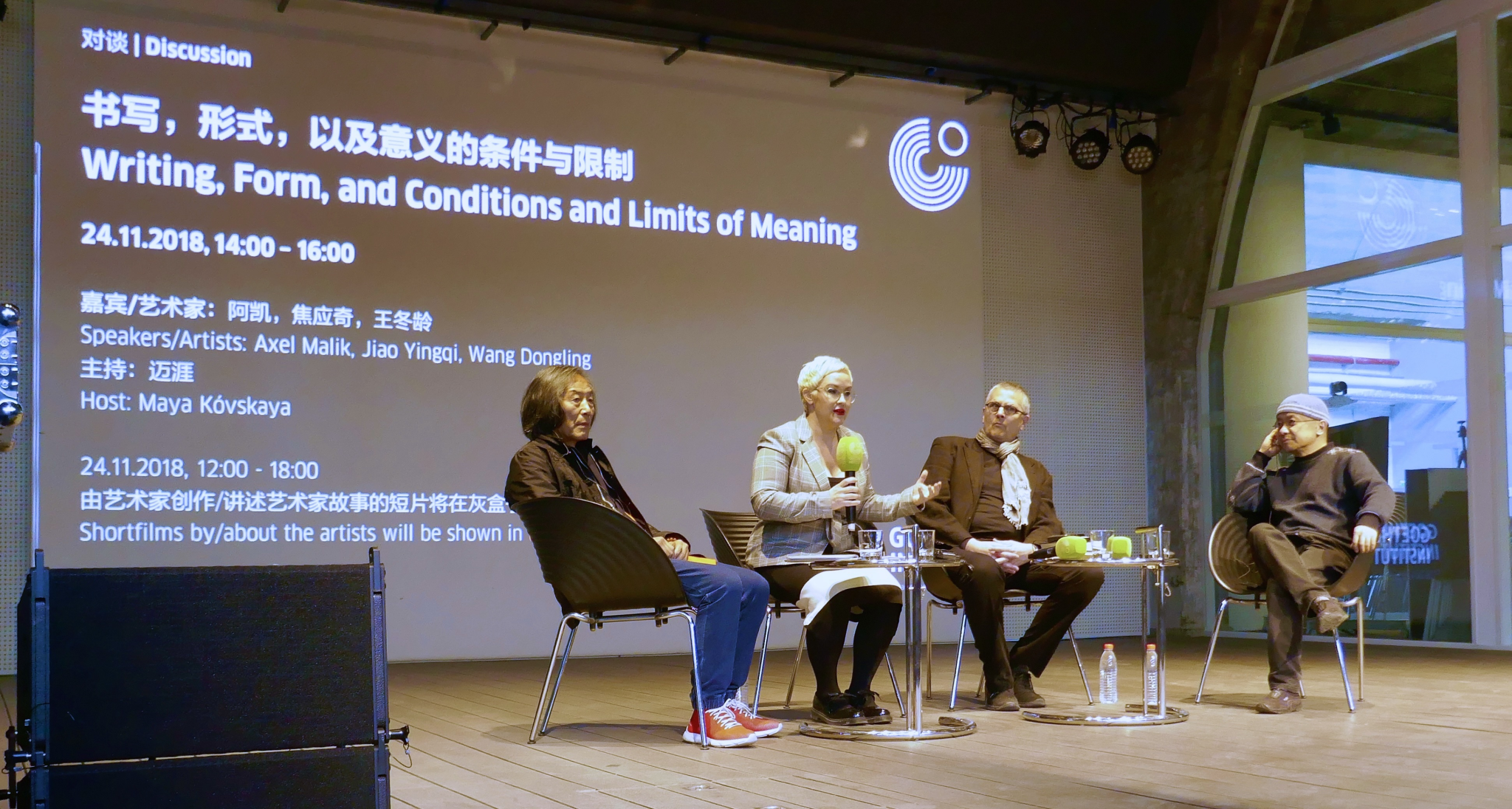
Malik’s direct engagement with China dates back to 2018. Invited by the Goethe-Institut, he travelled to Beijing, where he presented exhibitions and writing performances in connection with the Goethe-Institut and the 798 Art District. Together with the Chinese calligrapher Wang Dongling and the artist Jiao Yingqi, he also took part in a discussion on the “Writing, Form and Conditions and Limits of Meaning.”
In his studio, Malik also showed us books and materials that he had brought back from China. Rather than being preserved merely as souvenirs, they have been incorporated into his ongoing writing practice. His own signs overlap with and pass through the pre-existing texts and pages. His “China experience” has thus gradually become part of his broader system of writing—and continues to develop within that system to this day.
“Humboldt in Motion” in Contemporary Art
Malik is currently working intensively on a new body of work devoted to Alexander von Humboldt. During our studio visit, we were able to see several pieces that are still in the process of being created.
Malik explained how he approaches Humboldt’s manuscripts artistically. His interest lies not only in what Humboldt wrote, but also in the conditions under which those notes were produced—while travelling, observing, measuring, and reflecting. He therefore does not read the manuscripts solely as carriers of information. His attention is equally drawn to the visible traces of writing: lines and signs, different materials, ink marks, smudges, and transformations on the paper.
For Malik, Humboldt’s travel manuscripts reveal very different modes of writing. Alongside carefully developed observations and reflections are rapid notes, spontaneous entries, and traces directly connected with the experience of being on the move. Speed, movement, and external circumstances have all left their mark on the appearance of the script.
Malik’s works therefore direct attention not only to what Humboldt recorded, but above all tohow his writing took shape while travelling.
It is here that Malik sees a particularly strong connection with the long-term project of the Berlin-Brandenburg Academy of Sciences and Humanities, “Travelling Humboldt – Science on the Move”: Humboldt’s knowledge did not emerge independently of his travels, but through the very acts of observing, writing, and moving.
According to Malik, the works currently in progress are expected to be presented further in January 2027 as part of the Salon Sophie Charlotte, the Berlin-Brandenburg Academy of Sciences and Humanities’ annual event bringing together science and culture.

The visit to Axel Malik also forms part of the international academic and cultural activities of the Humboldt Center for Transdisciplinary Studies. Looking ahead, the Center will continue to expand its exchanges with academic and cultural institutions in Germany and across Europe, while embedding Humboldt research more firmly withinartisticnetworks. A particular priority will be to deepen transdisciplinary and intercultural dialogue and to generate new impulses both for Humboldt studies and for German-Chinese exchange in the humanities and cultural studies.